

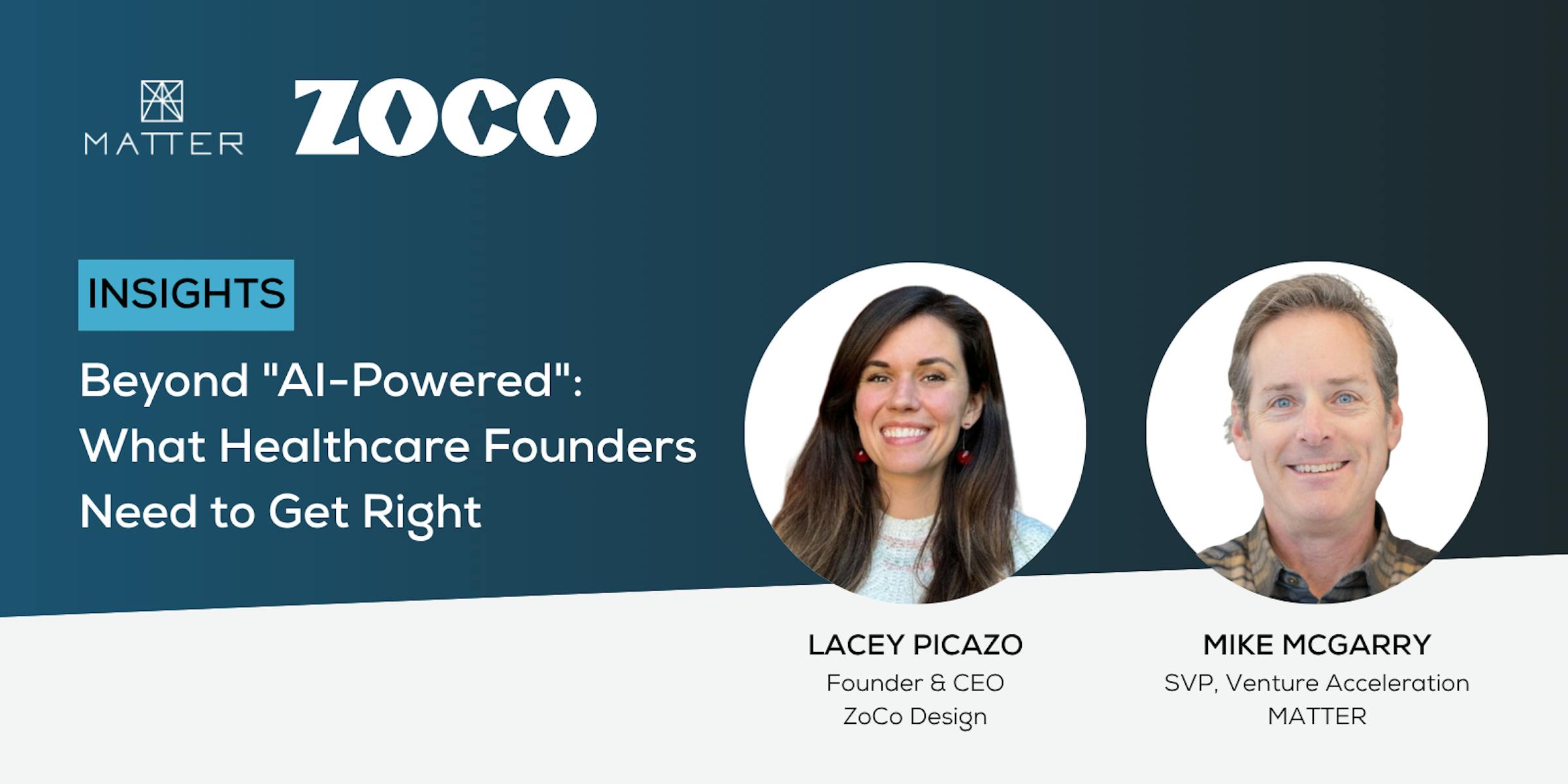

Beyond "AI-Powered": What Healthcare Founders Need to Get Right
In May of 2026, healthcare leaders from across Chicago met at MATTER’s headquarters to discuss what’s keeping them up at night. The event put a range of leaders, from new startups to investment groups, at a table for an authentic chat, and, no, it didn’t turn into a pitch competition. Instead, MATTER partnered with ZoCo, a healthcare-focused UX and research consultancy, to facilitate conversations and provide expertise. Everyone shared a challenge and then groups dug in with curiosity before giving recommendations.
Much of the discussion was unpacking what investors want to see from founders and how to effectively scale. Challenges shared centered on three themes: staying close to your users, clarifying your position in the market and, yes, a strategic application of AI.
To get a deeper perspective on the recommendations offered, we sat down with the event co-hosts, MATTER’s Senior Vice President of Venture Acceleration, Mike McGarry, and ZoCo’s Founder & CEO, Lacey Picazo.
When building a new solution in healthcare, how do you stay close to your users?
There was a lot of questions about differentiating a product or service in a noisy market from attendees. Peers advised that in order to find your moat, it’s valuable to deeply understand clinical workflows, domains and even upcoming regulatory changes. But how do you also prioritize staying embedded with users, be they clinicians or patients, to understand these things?
Lacey Picazo: Innovation in healthcare often starts because someone sees a problem that they want to solve. Most people building in health have spent time in the industry, and they want to fix the pains they’ve experienced. This is great. But it’s also not enough. Your proximity to the issue can distort, rather than clarify the needed solution.
So, whenever you’re developing something new, whether it’s a new startup or you’re expanding an existing company, prioritize conversations with your potential buyers and users. Before you start coding a solution, get curious.
At ZoCo, we begin by digging into workflows and workarounds. We poke at user pain points to see just how painful they are — what’s a bruise and what’s an open wound? Okay, not literally, but when it comes to gaining adoption of a new product or service, it’s critical to understand if there is motivation to justify switching. The status quo is almost always the biggest competition.
So as you listen to your users, ask who they report to, their incentives, what metrics they’re measured against, and what resources they are already putting towards the problem your product solves. Ask about the procurement process and what matters. Also consider who holds the purse strings, because the person who approves the expense of your tool is rarely the one who uses it.
Patterns will emerge to show you where you have a real pain to solve, the size of the opportunity, and what scale would need to be achieved for the business model to work.
Mike McGarry: I agree with Lacey that healthcare founders are incredibly mission-driven. Most don’t decide to start a company simply because they see a market opportunity. They do it because they’ve experienced a problem firsthand or watched someone they care about navigate the complexities of managing a health condition. That personal connection fuels their commitment to improving healthcare.
Many founders come to MATTER with a promising solution or early product or prototype and a strong perspective on healthcare, but their personal experience is just the starting point. Healthcare is incredibly complex, and a solution that works for one stakeholder may create challenges for another. Success means creating value for patients, providers, payers and the broader healthcare ecosystem. That’s why discovery can’t stop once you’ve built something. It should continue throughout the life of your company.
Staying close to your users means creating opportunities to keep learning. Don’t assume the first customer who says, ‘yes, this solves my problem,’ represents the entire market. A community hospital, an academic medical center and a health plan may all experience the same challenge differently. The more diverse your conversations and partnerships become, the better you’ll understand how your solution fits into the healthcare ecosystem currently and where it needs to evolve.
Additionally, once you form a partnership or pilot, don’t think of it as a one-time validation exercise. Stay engaged. Keep asking questions, check in regularly and create feedback loops that help you understand how your users’ needs are changing. Healthcare is constantly evolving, and your solution should evolve with it. The founders who continue listening, learning and iterating are the ones who build companies that stand the test of time.
When you have a prototype or hypothesis for your solution, how do you position it in the market?
Because this event had participants from new companies as well as venture capitalists, a frequent topic was how to position your product — not only to investors but to the end users as well.
Mike McGarry: I think this starts with having the discipline to be specific. In healthcare, especially right now, there are countless companies building AI solutions. The technology itself is rarely the differentiator anymore. What stands out is a founder who can clearly explain who they’re serving, what problem they’re solving and why they’re uniquely positioned to solve it.
The temptation is to tell people everything your platform can do. Investors and operators want evidence that you’ve validated the need, understand how your solution fits into existing workflows and can demonstrate measurable value, quickly. I encourage founders to lead with the one problem you understand better than anyone else and the value you create by solving it. The companies that differentiate themselves aren’t necessarily the ones with the most features — they’re the ones with the clearest understanding of where they fit, who they serve and why that matters.
Lacey Picazo: When it comes to how your product is positioned, everyone likes to talk about their thing holistically — the new tech, the features, the integrations. At ZoCo, we’ve found people connect better when you talk about what you do to improve their lives instead. There’s a subtle switch between ‘Our ambient listening is built for pathology.’ and ‘Never type another pathology report again.’ One tells me what you do. The other lets me picture my life with your tool. When it comes to positioning for investors, the messaging challenge becomes one of clarity. Can you summarize your solution in a sentence, maybe two? This doesn’t mean what you build can’t be complex. In fact, it probably needs to be in order to fit into the healthcare space, but you need focus in your narrative and pitch decks. Bring in that user research to show you’ve already done some validation and have even made pivots because of it. Avoid speaking to every bell and whistle, but tell a compelling, clear story. That’s what makes you memorable.
AI is everywhere in healthcare, and it isn’t slowing down. What role should it play going forward?
You can’t have an event in healthcare without talking about AI. Attendees shared concerns about integrating AI in their internal processes as well as their external solutions. Everyone is AI-powered now, but where do you see AI playing a critical role in the future?
Mike McGarry: AI is already changing healthcare. But we’re also moving past the point where simply saying your company is “AI-powered” is enough to stand out. As AI becomes more accessible, the technology itself is becoming less of a differentiator. What matters is how you apply it to solve meaningful problems.
The people delivering care want to spend more time caring for patients, but workforce shortages and administrative demands often get in the way. That’s why I think some of the biggest opportunities for AI are in solving persistent operational challenges — reducing administrative burden, supporting clinical decision-making where appropriate and fitting naturally into the workflows providers already use. If your solution creates more complexity than it removes, it won’t matter how sophisticated the technology is.
Ultimately, healthcare organizations won’t adopt AI because it’s AI. They’ll adopt it because it helps people do their jobs better, improves outcomes or creates measurable value. The technology should support the mission, not become the mission.
Lacey Picazo: I’m energized by applications of AI that reduce busywork and administrative burdens, especially in healthcare. Let’s move people towards fulfilling work. But, there are two considerations I think are important for AI in healthcare: the first is around building user trust. People adopt technology at different paces. Addressing this can mean adding friction at the right moments for the underlying trust to be established. You can do this through asking for human review of AI outputs, surfacing logic and sources, and allowing users to undo or reverse AI outputs. To enable the behavior you want to see, these patterns must be evident and not hidden, fully automated, within your tool. The second consideration is around internal processes and learning. It is so easy to ask Claude or ChatGPT for an opinion like ‘Is this a good idea?’ or ‘What am I missing?’ But over-reliance on an LLM, no matter how informed it may be, will dull your customer sense. Whatever you do, never stop talking to humans.
Conclusion
This is just the tip of the iceberg of what healthcare leaders talked about at the last Healthcare Roundtable. The roundtable format provided a safe, open forum for leaders to process their most pressing challenges. If you’re curious about what other leaders are saying or have a burning problem you need input on, fill out this form to be put on the waitlist for our next roundtable event.