


How AI could change the economics of commercial pharma
Leaders from Lundbeck, EVERSANA and Sanofi examine what changing commercial costs could mean for growth, partnerships and patient services.
Key insights
- AI could change the economics of commercial growth by helping manufacturers support more products and opportunities with existing resources.
- As AI changes the resources needed for commercial execution, manufacturers and agencies are reconsidering which capabilities they own and how they work together.
- Connecting fragmented healthcare data could help pharmaceutical companies develop services that better reach patients, including rural and underserved populations.
For pharmaceutical companies, the resources needed to bring a product to market and support it commercially can influence which opportunities are worth pursuing. AI could change that calculation. It could also change what manufacturers do themselves, what they need from agency partners and how they reach patients.
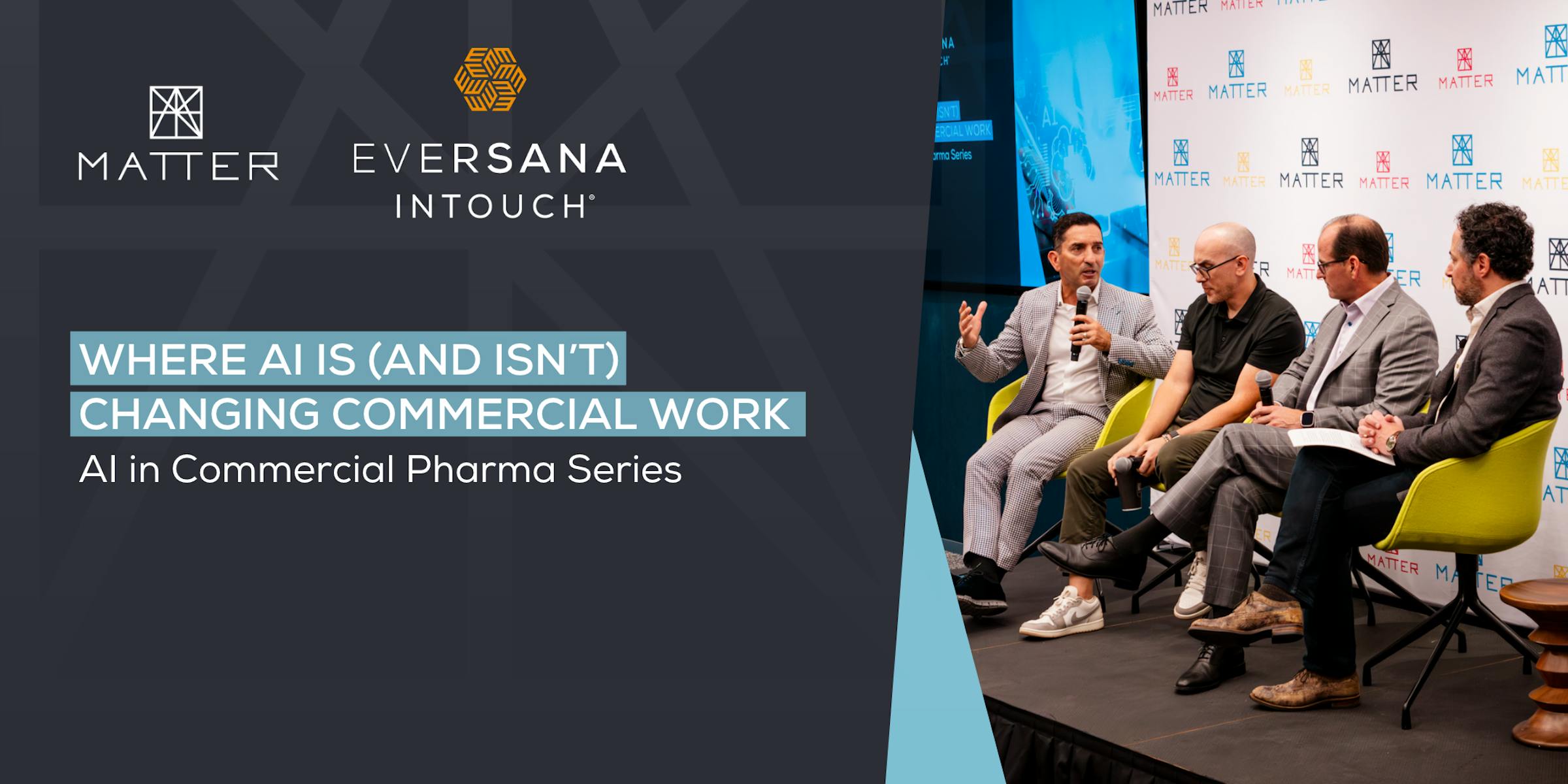
At the second event in MATTER’s AI in Commercial Pharma series, produced with support from EVERSANA INTOUCH, MATTER CEO Steven Collens discussed those possibilities with three industry leaders:
- Thomas Gibbs, executive vice president and president of Lundbeck U.S.
- Faruk Capan, chief innovation officer at EVERSANA and founder of EVERSANA INTOUCH
- Jared Josleyn, senior vice president and global head of EDGE (Emerging Disruptive Growth Exploration) at Sanofi
How much more could commercial teams accomplish?
Josleyn cautioned that improving existing processes doesn’t necessarily create new opportunities. “Optimizing how you did it in the past doesn’t mean that you’re creating new value in the future.”
Gibbs described how Lundbeck is approaching that challenge. His ambition is to expand what the company’s commercial organization can accomplish without proportionally increasing its resources.
To pursue that goal, Lundbeck has identified nine strategic areas for AI investment across the commercial value chain, including diagnosis, treatment, reimbursement and adherence. The company is examining how work can be redesigned to create additional capacity and support future growth.
Gibbs also pointed to iNavigate, a call-planning tool used by Lundbeck sales representatives, as an example of the company’s broader efforts to improve commercial performance. He reported that representatives using the tool saw 31% more new patient starts than those who did not.
“I’m trying to create scalability, so we can do 140% more with the same amount of resources.”
How could AI change the pharma-agency relationship?
AI could also change which commercial activities pharmaceutical companies handle internally and which they outsource to agency partners. Capan described how AI could reduce the resources involved in producing commercial materials while giving pharmaceutical companies more control over the process.
At EVERSANA INTOUCH, Capan’s team developed an AI-enabled platform for commercial asset creation. He described how work that traditionally involves about 50 people across specialized functions and approvals could instead be coordinated by four or five team members, with creative and scientific experts contributing as needed.
While the platform was initially designed for EVERSANA INTOUCH’s own teams, pharmaceutical clients began asking to use its capabilities within their own organizations.
That could change the agency relationship. Manufacturers may be able to handle more commercial work themselves and retain knowledge from past campaigns and launches, while agencies focus on the specialized expertise their clients still need.
Could AI expand whom commercial pharma can serve?
AI could also change how pharmaceutical companies develop and deliver services to patients. Josleyn pointed to the growth of direct-to-consumer healthcare as one sign that the relationship between pharmaceutical companies and patients is changing.
Josleyn highlighted fragmented healthcare data as a barrier to understanding patients’ needs across their care journeys. AI could help companies make better use of information across systems, creating opportunities to develop more personalized services and extend support to rural and underserved populations without requiring the same level of local infrastructure as traditional models.
What’s next for commercial pharma?
The examples from Lundbeck, EVERSANA and Sanofi suggest that AI could influence decisions well beyond individual commercial workflows. If companies can support more products, bring new capabilities in-house and reach patients in different ways, they may also need to rethink where they invest and whom they partner with.
MATTER’s AI in Commercial Pharma series brings together pharmaceutical executives, entrepreneurs and investors to explore how these changes could take shape.
The conversation continues November 5 with entrepreneurs developing AI solutions for commercial pharma. Registration is still open.