

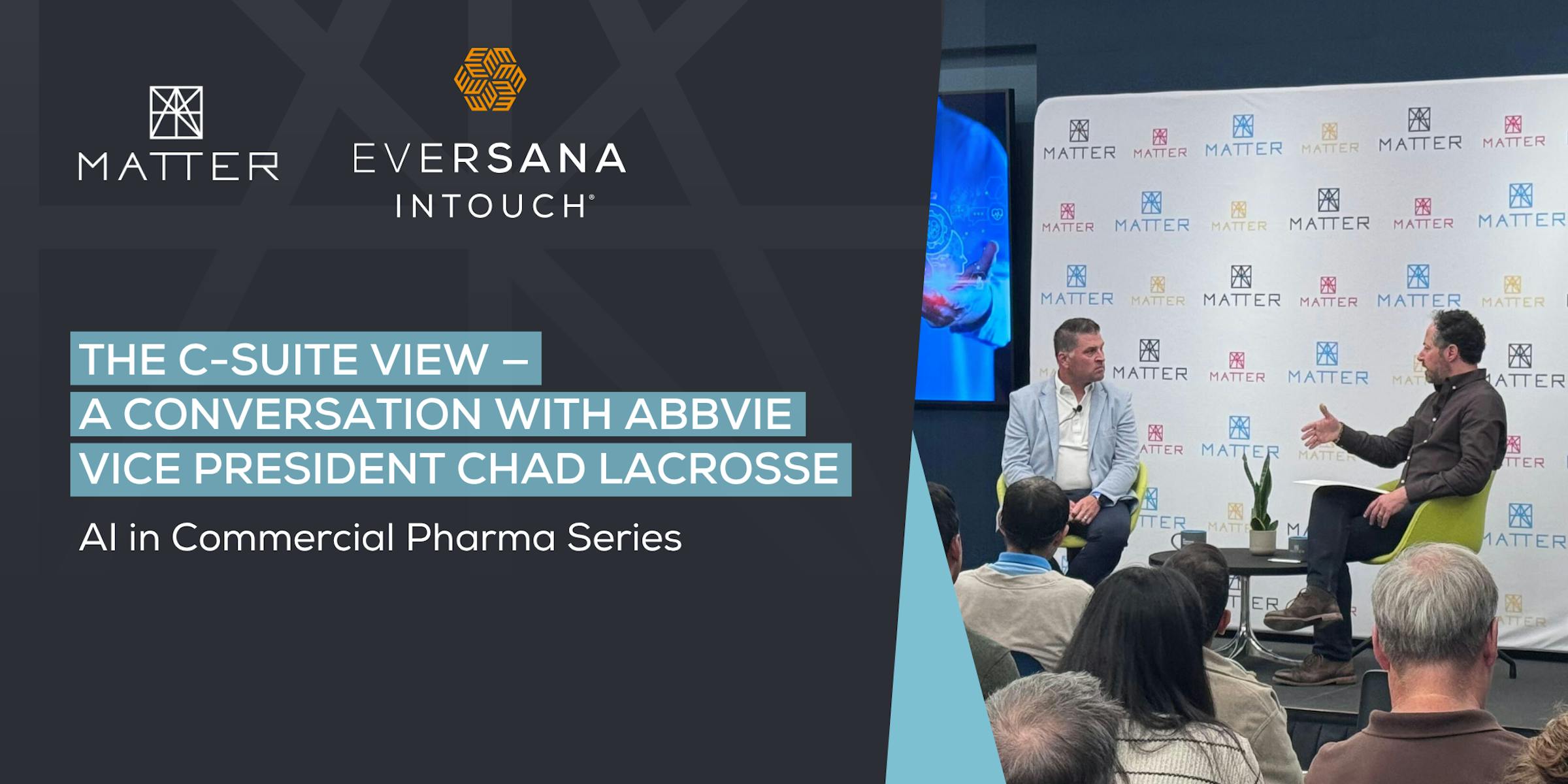

Where and how AI can create value in commercial pharma
AbbVie’s Commercial CIO Chad LaCrosse shares a framework for identifying meaningful AI opportunities across the commercial value chain.
Key insights
- Content development and review represent one part of AI’s potential in commercial pharma.
- AI opportunities span the commercial value chain, including brand strategy, patient access, HCP education, treatment initiation and adherence.
- Creating value requires four elements: process change, AI-ready data, technology and management conviction.
Content generation has dominated much of the commercial pharma conversation about generative AI. The technology can help teams create materials faster, review them more efficiently and navigate the complex medical, regulatory and legal approval process.
But that’s only the beginning: The commercial value chain presents a much wider set of opportunities.
AI can help teams understand patient needs, strengthen brand strategy, support healthcare professionals and address the barriers that prevent patients from starting or continuing treatment. Finding these opportunities requires leaders to look across the business and identify where better information, new capabilities or outside solutions could improve an outcome that matters.
This broader view guided the first event in MATTER’s AI in Commercial Pharma series, produced with the support of EVERSANA INTOUCH.
During The C-suite view of where AI is being used and what’s on the horizon, MATTER CEO Steven Collens spoke with Chad LaCrosse, commercial CIO at AbbVie, about where AI is beginning to change commercial work and what companies need to create lasting value.
Four variables determine the value
LaCrosse evaluates AI opportunities using a formula: process change, multiplied by AI-ready data, multiplied by technology, multiplied by management conviction.
“The multiplication symbols are important for those,” LaCrosse noted. “If you get a zero in any one of those, there’s zero value.”
The formula gives commercial leaders four areas to examine before committing resources.
- Teams must be prepared to adjust the processes surrounding their work.
- The data must include the information and context the technology needs.
- The technology must be capable of addressing the problem.
- Leaders must believe in the opportunity strongly enough to support change.
Process change may be the least visible part of an AI initiative, but it determines whether the technology becomes useful in practice. In some cases, the technology becomes another task and creates more work for the organization.
Embedding AI into the tools and workflows employees already use can reduce that burden. Instead of asking someone to interrupt their work and visit another platform, organizations can introduce AI at the point where information is reviewed or a decision is made.
Looking across the commercial value chain
When generative AI became widely available, commercial teams and their agency partners quickly recognized its potential for content development and review. That can be beneficial, but LaCrosse encouraged leaders to examine the rest of the work involved in bringing medicines to the patients who need them.
He outlined a commercial value chain that begins with creating brand strategies and compelling claims and continues through patient access, patient identification, HCP education, treatment initiation and adherence.
Across this whole value chain at AbbVie, any commercial AI initiative is expected to connect to one of three key outcomes: new patient starts, patient conversion and helping patients remain on their treatment plans.
LaCrosse emphasized this point during the conversation: “Don’t chase shiny objects. Come back to the formula that I talked about. Where do you have conviction that there’s value in your business unit? Let’s work on that.”
Preparing AI to understand the business
Commercial knowledge rarely lives in one place. Market research may be spread across shared folders. New findings may replace older research without the outdated material being clearly retired. Experienced employees may understand how decisions are made without ever documenting that reasoning.
LaCrosse compared AI to the world’s best-trained new employee arriving with no knowledge of the company, therapeutic area or competitive environment. That employee would need context and clear instruction before contributing to an important decision. AI needs the same preparation.
Creating AI-ready data means organizing information and capturing the context surrounding it. Teams need to document how they evaluate evidence, distinguish current information from outdated material and explain the factors that guide their decisions.
This foundation allows AI to support more complex work than summarizing documents or producing an initial draft.
Bringing the ecosystem together
Many of the most promising commercial AI opportunities will require more than a technology purchase. They may involve startups, healthcare professionals, patients, data partners and stakeholders from commercial, medical, legal and technology teams.
MATTER’s AI in Commercial Pharma series will continue examining these opportunities through conversations with commercial leaders, entrepreneurs and investors.
The next event on October 13 will feature Thomas Gibbs, president of Lundbeck U.S.; Jared Josleyn, senior vice president and global head of digital health and emerging disruptive growth exploration at Sanofi; and Faruk Capan, chief innovation officer at EVERSANA and founder of EVERSANA INTOUCH. They will discuss their approaches to AI: where they are finding value, how they are evaluating solutions, what they are building versus buying and what they see as the most significant barriers to adoption.